
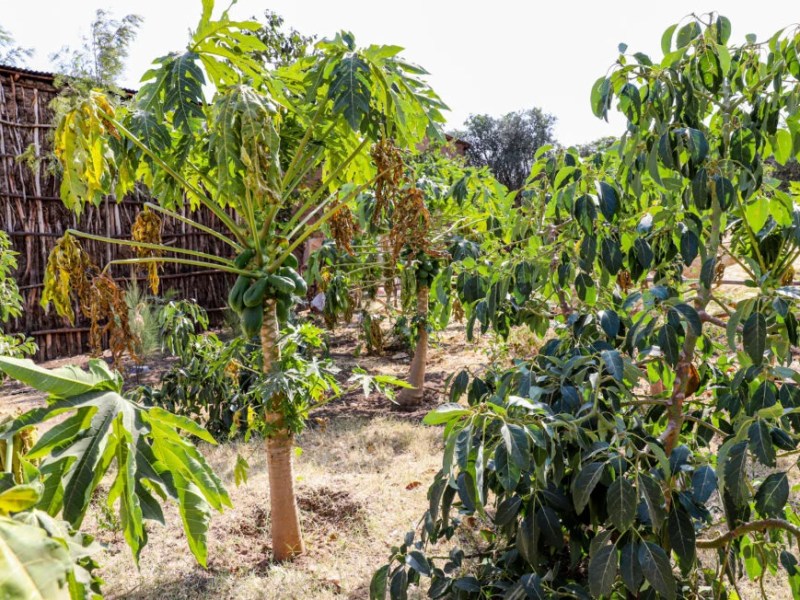
Mrs. Mamitu Kumbi never imagined that her 0.9 hectares of land could be productive enough to yield an abundance of various fruits prior to 2019.
“This area was bare, unproductive, and only used for waste disposal,” she recalls.
Initially hesitant when Regreening Africa introduced her to fruit tree farming, she decided to test the waters before fully committing.
Mrs. Kumbi learned about the project through community awareness campaigns and consultation meetings. She chose to participate when the project, in collaboration with Catholic Relief Services (CRS), offered training on home gardening, agroforestry practices, tree planting and management, as well as Farmer Managed Natural Regeneration (FMNR) practices.
Her curiosity drove her to become more involved, and she was selected to receive intensive training in agroforestry, along with fruit and tree seedlings and soil health management.
Upon completing the training, she received papaya tree seedlings, grafted mangoes, avocados, lemons, gesho, and several multipurpose trees like Grevillea robusta, Casuarina equisetifolia, Olea africana, Cordia africana, and Croton macrostachyus. These trees provide firewood, timber, cattle feed, and shade.
Despite her initial doubts regarding fruit tree farming, she decided to allocate a small piece of land, approximately 100 m², for planting the seedlings.
“I planted papayas and local vegetables, and when I had enough harvest to feed my family, I decided to grow more crops and fruit trees over a larger area.”
Now, Mamitu has established a fruit garden on her homestead as a source of income and a way to diversify her household diet.
Following her first harvest, she realized the potential of her entire plot to produce even more, and her skepticism began to fade. Empowered by her success, she tilled the remaining land and planted additional fruit trees. She also introduced gesho and various spices, such as chilies, garlic, rosemary, mint, basil, and ruda (tena-adam). With the money earned from selling these produce, she has been able to provide for her family.
“I benefit significantly—from improving my family’s diet to generating income through the sale of gesho seedlings, fodder, timber, and firewood,” she states.
Mrs. Mamitu earns an average annual income of 9,600 Ethiopian Birr from selling fruits and crops, which is about 181 USD.
Having witnessed the transformation of what she once viewed as barren land into a productive space, she now shares her knowledge and encourages fellow farmers to adopt home gardening practices because they are less labor-intensive and time-consuming.
She has cultivated a fruit orchard on her 0.9 hectares of land, growing a variety of high-value fruits, cash crops, and multipurpose trees.
“I didn’t expect such great results. Now, I grow fruits for my own consumption as well as sell them at the market. Selling the fruits helps cover my household expenses, preventing me from having to sell household assets.”
Home gardening has prompted a shift in mindset, as farmers like Mamitu are witnessing positive changes in their landscapes. With the income generated from fruit sales and the nutritional benefits derived from them, communities are now motivated to adopt these regreening practices.
The Regreening Africa Programme is a five-and-a-half-year initiative (2017-2023) funded by the European Union. It aims to enhance livelihoods, food and nutritional security, resilience to climate change, and ecosystem services through evergreen agriculture. In Ethiopia, the program is implemented by a consortium of international NGOs, led by Catholic Relief Services (CRS) and supported by World Vision Ethiopia (WVE) and World Agroforestry (ICRAF).
The Regreening Africa programme in Ethiopia has improved coordination and collaboration with government sectors, particularly at the woreda level. Its ultimate goal is to foster a large and sustained movement for landscape restoration with widespread adoption. The project builds on the successes of existing restoration initiatives, laying the groundwork for a nationwide scale-up.
This story was produced with the financial support of the European Union. Its contents are the sole responsibility of Regreening Africa and do not necessarily reflect the views of the European Union.